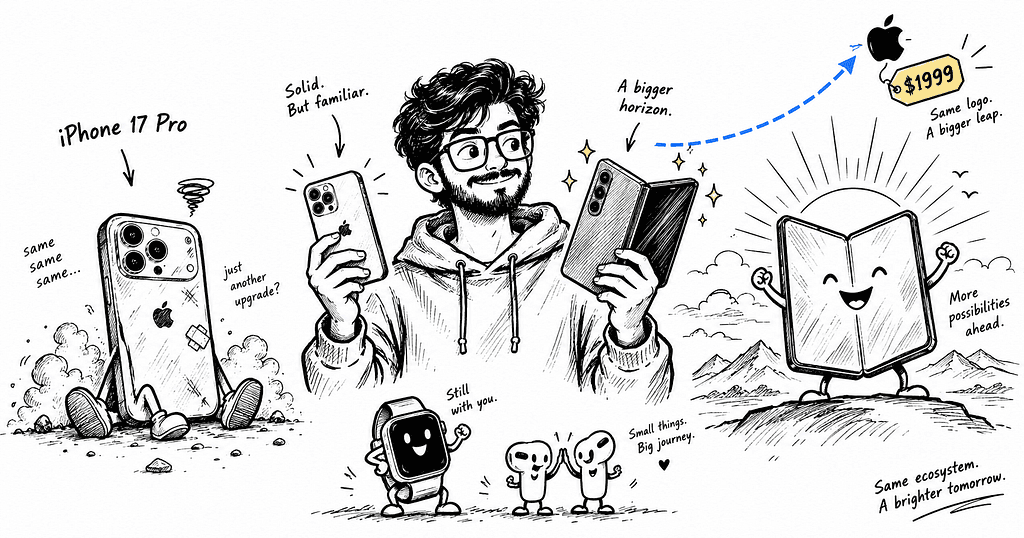
"I've been watching Apple events since the iPhone 6 era. This one felt different from the first frame."

I watched the whole keynote twice.
Once live. Once again immediately after, taking notes on the parts I missed the first time because the iPhone Duo demo was too distracting to process at normal speed.
This isn't the recap with bullet points and a summary table. This is the full depth version — what changed from last year, what's actually new, what iOS 27 looks like on the Duo, and what you should actually care about before the reviews land.
Let's go product by product.
📱 iPhone 18 Pro + Pro Max: What Actually Changed from 17 Pro
This is the part most recaps rush through. Let me slow down.
The A20 Pro Chip — More Than a Number Bump
The jump from A19 Pro to A20 Pro isn't a standard tick. This is the first iPhone chip built on TSMC's 2nm node — and the architecture change is real.
The A20 Pro uses WMCM packaging — Wafer-Level Multi-Chip Module — which means the chip is smaller physically while being more powerful. The result: roughly 18% faster performance and up to 30% better power efficiency over the A19 Pro. The GPU goes 7-core with a wider memory interface and a larger L2 cache on the efficiency cores.
The part that matters most for what's coming: Apple added a second neural engine specifically for on-device AI processing. The iPhone 18 Pro is being positioned as the AI device — not just an iPhone with AI features. That second neural engine is what enables real-time processing of Siri AI requests locally, without routing to the cloud, on supported queries. The Foundation Models framework developers have been waiting for since WWDC — this chip is what makes it actually fast.
For upgraders from iPhone 16 Pro: the 3nm to 2nm jump is substantial. For 17 Pro owners: the gains are most noticeable in sustained AI performance and battery endurance, not raw speed.
The Dynamic Island Got Smaller. Noticeably.
The Dynamic Island on iPhone 18 Pro is reportedly 35% narrower than on the 17 Pro — achieved by relocating the infrared flood illuminator under the active OLED panel. Only the TrueDepth camera is now visible above the display. Apple kept Face ID, but hid more of its hardware under the screen.
The result: more usable screen real estate on a 6.3-inch body that doesn't grow. Same physical size. Bigger feeling display.
Camera: What Changed and What Didn't
The main camera sensor is still 48MP. That didn't change.
What changed:
Variable aperture on Pro Max. The rear main camera on the iPhone 18 Pro Max physically adjusts its lens opening to control how much light reaches the sensor. This is the feature the camera community has been asking for. Real bokeh from a real aperture change — not computed. In bright light it stops down to manage exposure. In low light it opens up for maximum capture. Apple confirmed this is Pro Max exclusive this year. The standard Pro does not get it.
Camera Control simplified. The capacitive swipe gestures are gone. No more accidentally triggering zoom while trying to press. Just a pressure-sensitive button now. Clean.
24MP selfie camera. Up from 18MP on the 17 Pro. The front camera now shoots at a higher resolution and inherits the Center Stage square-sensor architecture from the 17 Pro for better framing.
Apple Reference Image. This is a new feature that adds metadata to every photo proving it isn't AI-generated, with a reference version of the image stored alongside every edit so the original source can always be verified. In an era where AI-generated images are everywhere, this is Apple building a provenance system directly into the camera. Quiet announcement. Big long-term implications.
Battery: The Real Story
iPhone 18 Pro doesn't have a dramatically larger battery in mAh terms — it's roughly a 2% increase in cell size on the global model. But the A20 Pro's 30% efficiency improvement means those cells last longer. Apple is claiming iPhone 18 Pro matches the video playback hours of the old iPhone 17 Pro Max. That's a significant real-world claim from a smaller body.
iPhone 18 Pro Max is where the battery story gets impressive. A 5,567 mAh cell — the largest ever in a Pro iPhone — combined with 2nm efficiency. Apple claims up to 30 hours of video playback.
Colors and Design
Black, Light Blue, Glacier (Silver), Burgundy. No Dark Cherry — that leaked name didn't survive. Burgundy is the standout. The camera plateau is slightly thicker to accommodate the variable aperture mechanism on the Pro Max, giving it a subtly different profile from the 17 Pro Max.
Pricing vs. 17 Pro
Model iPhone 17 Pro iPhone 18 Pro Difference Base Pro $1,099 $1,199 +$100 Base Pro Max $1,199 $1,299 +$100
$100 increase. Analysts were predicting $200–300. Apple blinked. The 2TB storage option appears for the first time on both models.
Pre-orders: September 12. Launch: September 18.
📲 iPhone Duo: Every Single Detail
This is the one. Let me go through everything confirmed from Apple's own newsroom and live demos.
The Name and Why It Fits
Apple called it Duo. Not Ultra, not Fold. Duo — because the entire philosophy is duality. Two displays. Two modes. Two identities in one device.
Build Quality
Grade 5 titanium frame. The hinge is a titanium-aluminum blend containing more than 100 components — Apple made a point of this number. They've been engineering this hinge for years specifically to eliminate the failure modes they watched competitors deal with.
No physical SIM tray. Global eSIM only.
The Displays — Both of Them
Outer display: 5.4-inch Super Retina XDR. Designed for one-handed conventional use. ProMotion. Always On. Peak outdoor brightness of 3,000 nits. Same aspect ratio as the inner display, which means content transitions naturally as you open it.
Inner display: 7.6-inch Retina display. Apple says it's 50% larger than the iPhone 18 Pro Max screen. Also ProMotion. Always On. 3,000 nit peak brightness.
The inner display uses a nano-texture finish — the same anti-reflective technology Apple introduced on the iPad Pro. This serves two purposes: reduces reflections, and makes the crease far less noticeable in real-world use. Apple has said they focused heavily on eliminating the crease experience. The nano-texture approach is their answer.
Both displays share the same aspect ratio. That's not an accident — it means apps don't have to redraw differently between screens. Transitions feel seamless because the content geometry stays consistent.
Face ID? Touch ID?
No Face ID. There isn't enough room in the hinge-based design to fit the TrueDepth camera system at the top. Apple went with Touch ID in the power button — the same implementation they use on the iPad Air and iPhone SE. You can also unlock with an Apple Watch if you have one paired.
The Camera System
Two 48MP rear cameras — Wide and Ultrawide. Horizontally positioned on the rear, similar to how the iPhone Air lays out its cameras. No telephoto this generation. Apple made a deliberate choice: the Duo is not a Pro-replacement, it's a new form factor in its own category.
Two front cameras — one 12MP per screen. When you're using the outer display, the outer camera is active. When unfolded, the inner camera handles calls and selfies.
Apple Pencil support is confirmed — but shipping later this year via a software update. Both the USB-C Apple Pencil and the standard Apple Pencil with USB-C will work across both displays.
Storage Options
256GB, 512GB, 1TB, 2TB.
Pricing
Storage Price 256GB $1,999 Up to 2TB ~$3,000
Apple reportedly sacrificed margin to hit the $1,999 number instead of the $2,500 many analysts predicted. The goal is adoption. They want Duo to actually sell, not just exist.
Pre-orders: October 16. Launch: October 23. Limited initial supply — foldable production constraints are real.
Colors
Star White and Night Sky. That's it. Two options, both premium-feeling.
📱 iOS 27 on the iPhone Duo: The UI You Haven't Seen Before
This is the section I'm most excited to write about. Because this is where Apple really showed its work.
iOS 27 on the Duo is not just iOS with a bigger screen. Apple rebuilt significant parts of the interface specifically for this form factor.
The Home Screen — Redesigned for the Fold
When you open the Duo, the home screen doesn't just stretch to fill the larger canvas. It reorganizes. Essential controls — Control Center toggles like Wi-Fi, Bluetooth, brightness — move to the side edges of the display rather than the top. This preserves maximum vertical workspace for apps. The dock at the bottom gets a vertical orientation option.
The lock screen on the inner display is minimalist — Apple said it emphasizes the wallpaper, letting the larger canvas breathe rather than packing it with status elements.
Split View — iPhone Gets Real Multitasking
For the first time on iPhone, you can run two apps side by side in full Split View.
Not picture-in-picture. Not a floating window. Actual split screen.
You move an app to one side of the inner display and launch a second one on the other half. Want two Safari windows open? You can launch two windows of the same app — the demo showed comparison shopping with two browser tabs sitting side by side, which has never been possible on iPhone before.
App Pairs. You can tap the divider between two apps in Split View, and it saves that combination. Next time you want Mail + Notes open together, they launch as a pair in one tap. Gestures let you swap apps between sides or change which side they're on.
The Folded Mode — Half-Fold Is a Real Use Mode
The Duo knows when it's partially folded — those foldState and angleDegrees variables Apple engineers leaked in the iOS 27 beta in June? This is what they were for.
When you fold the Duo to roughly 90 degrees and set it on a table, iOS detects the angle and automatically moves UI elements away from the fold crease — so all the interactive content is on the half you're looking at. It's the same concept as the Samsung Flex Mode, but integrated at the OS level across all apps rather than needing per-app support.
You can sit Duo on a desk in this mode and take hands-free video calls, watch content at a natural viewing angle, or follow a workout without holding the phone.
StandBy — Now Works Without Power
One of the quietest but most useful changes: StandBy mode on the Duo works even when it's not plugged in. Stand it up on a nightstand. It becomes a clock, a photo frame, a weather widget display. No cable required.
On every other iPhone, StandBy requires charging. The Duo's larger battery makes this possible without running the device down.
Vertical Pinning
When using the Duo unfolded in portrait orientation, you can pin a video to the top half and use any other app in the bottom half simultaneously. Watch a YouTube video on the top, reply to messages on the bottom. The video stays put while you work below it.
Siri AI on Duo — The Best Version
The inner display's larger canvas makes the Siri AI conversation window genuinely useful. Apple showed a full conversation-style Siri interface that takes advantage of the extra space — not just a slim bar at the bottom of the screen, but a rich persistent conversation panel that works alongside other apps. Apple specifically called Duo the best device for Siri AI.
⌚ Apple Watch Series 12: What's New vs Series 11
This is a health-focused upgrade, not a design refresh. Same case. New internals. New sensor array.
The New Health Sensing System
Apple gave the Series 12 what they're calling an all-new Health Sensing System. The changes:
Larger electrode surface for improved skin contact during ECG readings
Photodiodes arranged in a ring to capture light more efficiently for heart rate and blood oxygen
Larger, more sensitive accelerometers for more precise motion detection
The practical result: all-day continuous heart-rate monitoring is now more accurate and less power-hungry than on the Series 11.
Readiness Score. New feature that aggregates your sleep, activity, and heart rate data into a single daily readiness metric — similar to what Oura Ring has been doing but built into Apple Health natively.
AI Day Summary. watchOS 27 adds an Apple Intelligence-powered end-of-day summary: what activities you did, trends in your metrics, and personalised recommendations. The Health app has also been redesigned to show long-term trends rather than just today's data.
The S11 Chip
The Series 12 runs the new S11 chip — the first meaningful chip jump in the Watch line after two generations with the S10. Performance improvement for AI-driven health analysis and faster app launching.
Ceramic Case Returns
Apple hasn't offered ceramic Apple Watch cases since the Series 5 in 2019. It's back on the Series 12 in two finishes: white and dark gray. No pricing confirmed yet, but the old ceramic Edition started at $1,299 — expect this to sit well above the standard $399 entry point.
Ceramic Shield 2
The aluminum model's front glass is now Ceramic Shield 2 — Apple claims 60% tougher than the Ion-X glass on the Series 11. Meaningful for everyday wear.
5G RedCap
First 5G connectivity in Apple Watch history. LTE is still there, but Series 12 now also supports 5G RedCap (Reduced Capability) — a low-power 5G standard designed specifically for wearables. Faster data when you need it, without killing the battery.
Battery life: 24 hours unchanged. Up to 38 hours in Low Power Mode. Fast charging to 80% in 30 minutes.
Pricing: Starts at $399. Pre-orders open today. Launch September 18.
⌚ Apple Watch Ultra 4: The Endurance Watch
Honest take: this is the thinnest upgrade story of the event.
What's new:
Larger battery with improved efficiency — two days of battery life claimed
Up to 18 hours of workout tracking with full GPS + heart rate
Extended workout mode: 45 hours
Same redesigned Health Sensing System as Series 12 (larger electrodes, ring photodiodes)
Black and Natural titanium finishes
New titanium Hermès band
Siri AI via watchOS 27
What's the same: Same case design as Ultra 3. Same rugged titanium build. Same Action Button.
Ultra 3 owners: this is a battery and health sensor bump. The case didn't change. Skip unless two-day battery life is specifically what you need.
Pricing: Starts at $799. Pre-orders today. Launch September 18.
🎧 AirPods 5: Two Models, Honest Summary
Two AirPods 5 variants. That's the main structural change.
AirPods 5 (standard): Updated chip, better call quality, no ANC
AirPods 5 ANC: Active noise cancellation, updated chip
The camera AirPods that would feed data into Visual Intelligence — confirmed 2027. Not today.
🧭 My Honest Take Before The Reviews Land
The iPhone 18 Pro is a solid chip-and-camera upgrade if you're on anything older than a 17 Pro. If you're on 17 Pro, the only compelling reasons are the battery and the camera if you care deeply about computational vs physical aperture.
The Duo is the interesting one. And I don't mean interesting in a polite way — I mean it's genuinely unclear yet whether the nano-texture crease fix works as well as Apple claims, whether the split view is actually useful for phone-sized tasks, and whether $1,999 makes sense for a first-generation foldable when the iPhone 18 Pro Max gives you more camera capability for $700 less.
Tags: Apple, iPhone 18 Pro, iPhone Duo, Apple Watch Series 12, iOS 27, Foldable iPhone, John Ternus, Mobile Development
Apple "Surprise and Shine": Every Product, Every Upgrade, Every Minor Detail 🍎 was originally published in Stackademic on Medium, where people are continuing the conversation by highlighting and responding to this story.