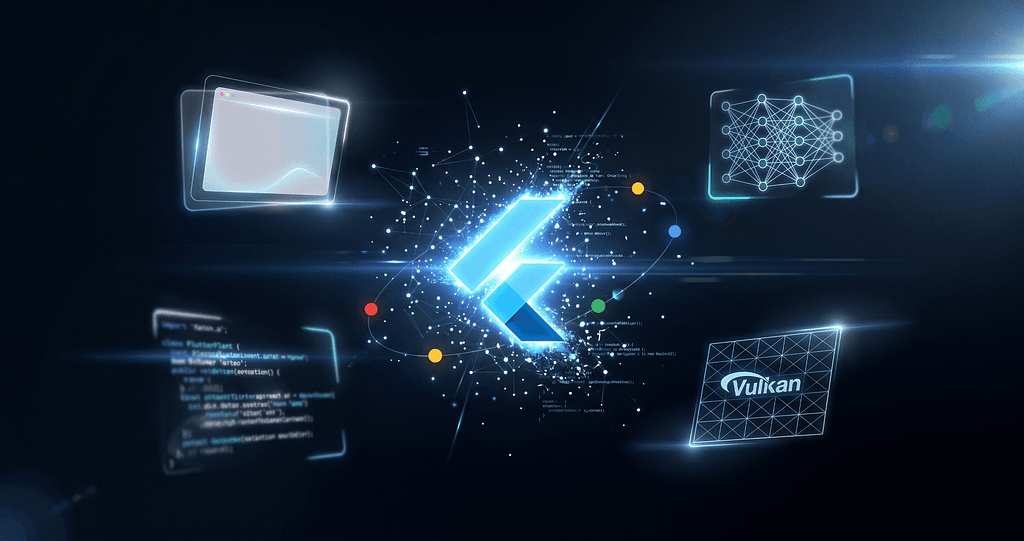

“The most dangerous moment in any platform’s life is when it stops being a tool and starts being infrastructure. Flutter just crossed that line.”
Let me tell you about a conversation I keep having with other Flutter developers.
It usually starts with: “Is Flutter actually worth it long-term?” Someone mentions the Material widget constraints. Someone else brings up the app store update cycle problem. A third person wonders when AI tooling will actually understand their Dart codebase instead of hallucinating widget names.
Google I/O 2026 just answered all three of those questions at once — and the answers are bigger than most people are processing.
This isn’t a features list. There are plenty of those. This is a developer’s read of what these announcements mean for how we actually build — and what you should be thinking about differently starting this week.
First, The Framing: Flutter Is No Longer Just a UI Toolkit 🧭
That sounds dramatic. Let me back it up.
The original promise of Flutter was: write once, render everywhere, with pixel-perfect fidelity. It delivered on that. But it was still fundamentally a UI rendering toolkit — your backend logic, your AI integrations, your tooling, your state management — those were all bolted on.
What I/O 2026 describes is something categorically different: Flutter as a full-stack, AI-native development ecosystem. The core is getting leaner. The AI layer is getting integrated at the SDK level. The tooling is getting semantically aware. These aren’t incremental updates. This is architectural evolution.
Personal reflection #1: I’ve been building Flutter apps long enough to remember fighting Material’s opinionated defaults on every custom design brief. The number of times I’ve hacked around ThemeData to get a genuinely clean, system-agnostic UI is not small. When I read that Material and Cupertino are moving to standalone pub.dev packages, my first thought wasn't "interesting." It was "finally." The frustration that announcement resolves is real, and it's been real for years.
GenUI SDK + A2UI Protocol: This Is the Biggest Shift 🤖
Let me spend real time on this one because I think it’s being underestimated.
Flutter GenUI SDK + the A2UI protocol means AI models can now dynamically generate and adapt rich UI based on user intent. Not templates. Not pre-configured layouts. Live interfaces generated in response to what a user is trying to do.
The technical enabler is what makes this actually work rather than just being a demo: Dart is investigating interpreted bytecode support within the runtime. This unlocks ephemeral code delivery — loading dynamic UI portions on-demand without a full app store update.
Think through what that means architecturally.
Right now, a personalized UI means: you ship every variant, you A/B test, you deploy updates through a review pipeline. With ephemeral code delivery, you can respond to intent in near-real-time. The UI becomes a function of the user’s context, not a pre-shipped artifact.
That is not a feature. That is a new way of thinking about what an app is.
Personal reflection #2: When I built synapse-cortex — a local-first MCP server giving AI agents persistent memory and knowledge graphs — the core problem I was solving was: how do you make an AI agent useful when it needs to understand context that wasn’t in its training data? The GenUI + A2UI pattern is solving the same problem at the UI layer. The interface needs context. It needs to understand intent_, not just respond to taps. These two things are going to converge fast._
Actionable takeaway: Start thinking about your UI architecture as intent-responsive rather than state-responsive. Even before GenUI SDK is stable, you can begin designing your widget hierarchy with dynamic composition in mind. What parts of your UI are truly static? What parts should adapt? Map that now.
Agent Skills + Local MCP: AI That Actually Understands Your Codebase 🧠
This one is personal for me.
I’ve spent time building with AI coding assistants. The consistent frustration: the AI doesn’t know my project. It knows Flutter in the abstract. It knows Dart syntax. But it doesn’t know my custom BaseRepository pattern, my widget naming conventions, my state management architecture. So every suggestion is a probabilistic guess dressed up as a recommendation.
Agent Skills for Dart and Flutter, integrated with the open Model Context Protocol (MCP), changes that.
Your AI assistant now hooks directly into your local Dart SDK analyzer. Zero configuration. Full project context. It understands your widget tree, your custom types, your imports. Deep architectural refactoring, type-safe validation, native test suite execution — all local, all semantically accurate.
The hallucination problem that makes AI coding assistants frustrating in complex Flutter projects? That’s what this is designed to solve.
Personal reflection #3: I’ve been watching the MCP ecosystem closely — obviously, given what I built with synapse-cortex. The pattern of giving AI agents access to local context through a structured protocol is exactly what makes the difference between “useful” and “actually replaces manual work.” Google formalizing this at the Flutter SDK level means MCP is now a first-class concept in the Flutter development workflow. That’s a much faster adoption curve than anything coming from the community alone.
Actionable takeaway: If you haven’t explored MCP integration in your development environment yet, start now. The Flutter-native MCP tooling announced at I/O will make this easier — but the mental model of “give your AI agent structured access to your local environment” is something you can experiment with today.
The Universal Canvas: A Blank Engine to Paint On 🎨
This is the architectural change I’ve been quietly hoping for.
Flutter is moving Material and Cupertino design libraries out of the core flutter/flutter repository and into independently versioned packages on pub.dev. The core engine becomes what it always should have been: a fast, lightweight, unopinionated rendering canvas.
What does this unlock practically?
When you’re building a product with its own design language — not Material Blue, not Cupertino Gray, but your system — you currently fight the defaults constantly. Every ThemeData override, every InheritedWidget workaround, every MaterialApp wrapper you strip back to bare metal is friction the platform was creating. The Universal Canvas removes that friction at the foundation level.
For anyone building genuinely custom, premium interfaces — the kind of UI that wins design awards or ships as a flagship enterprise product — this is the change that makes Flutter the right tool for the job in a way it wasn’t cleanly before.
Personal reflection #4: I’ve been an architect on enough Flutter projects to know the exact moment a client’s designer hands you mockups and you internally calculate “how much of this is going to be fighting Material?” That calculation just changed. The core rendering engine is now my ally, not my adversary. That shift affects how I write proposals, how I scope timelines, and how I pitch Flutter to stakeholders who’ve heard “but it looks like a Material app.”
Actionable takeaway: If you have an upcoming project with a custom design system — don’t constrain your architecture to Material patterns in anticipation of future compatibility issues. Design system first, rendering engine second. That’s now a viable path.
Pure Impeller: The Multi-Year Story Reaches Its Conclusion ⚡
The Impeller saga is finally closed.
Skia is officially being deprecated for Android 10 and above. Pure Impeller Vulkan rendering is now the singular path forward on modern Android. That means:
Predictable, jank-free animations — not “usually smooth, sometimes not.” Consistently smooth. Faster startup-to-interaction times. Cold starts that don’t feel cold. A single rendering path to optimize for, profile against, and reason about.
The “Impeller is on by default but Skia fallback exists” era created a confusing split reality — you couldn’t be certain which renderer your users hit in what conditions. That ambiguity is now resolved.
Personal reflection #5: The security plugin I maintain — enhanced_jailbreak_root_detection — has taught me that performance consistency matters enormously for security-sensitive flows. A jank during a biometric authentication prompt isn't just an aesthetic problem; it erodes trust in the interaction. Pure Impeller on Android means I can make stronger guarantees about rendering consistency in security-critical moments. That's not a minor improvement.
Actionable takeaway: Run your performance benchmarks on Impeller-only now. If you’ve had Skia fallback enabled as a hedge, remove it in your next development build and profile. Find the regressions before your users do.
WasmGC DevTools: 200ms That Actually Matters 🛠️
I know “DevTools got faster” doesn’t sound like a headline. But 200ms of lag during telemetry parsing removal is not a small deal if you do serious profiling work.
DevTools compiled to WasmGC by default means the profiling and debugging experience is now fluid in a way it wasn’t before. The stutter during heavy analysis sessions — the one that made you question your reading of the flame chart — is gone.
For developers doing performance-critical work (game development, animation-heavy UIs, complex list virtualization), this is the difference between profiling being painful and profiling being productive. Those are different things.
Actionable takeaway: Update your DevTools immediately when the release drops. Run a profiling session on a performance-heavy screen in your current app. The clarity improvement is worth the 15 minutes.
Firebase Intelligence Layer: The AI Understands Your Environment 🔥
Firebase’s Agent Skills now explicitly cover Flutter, iOS, and Android environments with environment-aware context.
What this actually changes: AI agents working on your Firebase infrastructure now understand the nuances of your specific platform. Not generic Firebase advice — Flutter-specific Firebase integration patterns, the particular way Firebase Auth interacts with platform navigation, the differences in Firestore listener management on mobile vs web.
That contextual specificity is what eliminates infrastructure hallucinations. Anyone who’s had an AI confidently generate Firebase rules that seemed right but broke their security model knows exactly the problem this solves.
Personal reflection #6: I’ve seen more AI-generated Firebase security configurations that “looked correct” but had subtle holes than I care to admit. Not because the AI didn’t know Firebase — it did. But it didn’t know Flutter’s specific patterns around user lifecycle, anonymous auth flows, or token refresh behavior. Environment-aware context bridges that gap. It’s the same reason local MCP matters: generic knowledge isn’t the same as contextual knowledge.
What I’m Changing in How I Build 🛠️
This isn’t abstract for me. Here’s what actually changes in my workflow:
Immediately: Profile everything against pure Impeller. Remove Skia fallback hedges. This is stable and production-ready now.
This sprint: Evaluate DevTools WasmGC performance on my heaviest profiling sessions. If the improvement is what I expect, it changes how frequently I run profiling passes.
This quarter: Begin designing new project architectures with the Universal Canvas model in mind. Stop constraining widget hierarchy to Material patterns when the project doesn’t call for them.
Watching closely: GenUI SDK and A2UI protocol developer preview timeline. This is the one that changes what an app fundamentally is — and I want to be building with it as early as stable preview allows.
Long-term architectural shift: MCP-native development tooling. I’ve been building in this direction with synapse-cortex. Flutter formalizing MCP at the SDK level is the ecosystem catch-up I’ve been waiting for.
The Honest Section ⚠️
Not everything announced is in your hands today.
GenUI SDK and A2UI protocol are investigative / early preview — not production-ready. Dart interpreted bytecode is being explored, not shipped. The Universal Canvas pattern requires package ecosystem maturity that takes time to develop after core changes land.
The announcements are real and directionally exciting. But the gap between “announced at I/O” and “stable API I can ship against” is a gap you should plan for, not around.
Actionable takeaway: Build your roadmap against what’s stable. Build your architectural thinking against what’s coming. Those are two different timelines and conflating them is how you end up either behind or blocked.
Try It, Break It, Tell Me 🤝
The Flutter I/O announcements I’m personally exploring deepest this cycle:
- Impeller-only profiling passes on enhanced_jailbreak_root_detection's security flows
- MCP local integration patterns — and how they map to what I built in synapse-cortex
- Universal Canvas architecture for an upcoming project with a custom design system
Check out what I’ve been building:
- synapse-cortex — local-first MCP server giving AI agents persistent memory. The architecture Google’s Flutter MCP integration is pointing toward, built from the community side.
- enhanced_jailbreak_root_detection — Flutter security plugin. Pure Impeller just made security-critical rendering more reliable. Timing.
Drop a ⭐ if they solve something you’ve felt.
What Flutter I/O announcement are you diving into first? Drop it in the comments — I read every one.
Follow me on Medium for more writing on Flutter architecture, AI-native development, and building in public.
Keywords: Flutter Google I/O 2026 · Flutter GenUI SDK · A2UI protocol · Dart bytecode · Flutter Impeller · Flutter Universal Canvas · Flutter MCP · Agent Skills Flutter · Firebase Flutter AI · WasmGC DevTools · Flutter architecture 2026 · Flutter AI-native · Dart Flutter developer