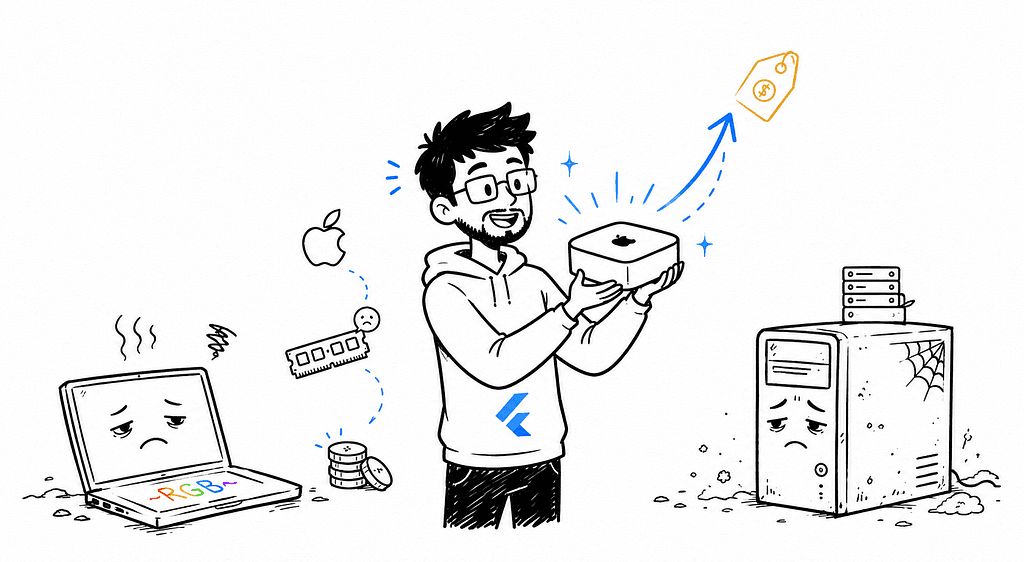
“Thanks a lot, AI. You made my dev machine more expensive before I even got to use you to build anything.”

Apple just refreshed the Mac mini for the first time in two years, and the internet’s reaction has been pretty much one note: the price went up, and it went up a lot. Fair reaction, honestly. But after actually digging into why it went up, and weighing it against what building an equivalent Windows box costs right now, I landed somewhere different than the outrage cycle.
Here’s what’s actually new, why the price hike isn’t really an Apple-being-greedy story, and why I’d still pick this over a Windows machine even at the new price.
Where I’m Actually Coming From 🏠
“Two machines already. Neither of them is going to cut it for what I’m about to need.”
Worth being upfront about my starting point here, because it shapes the whole argument. Right now I’ve got two machines at home. A GTX 1650, Ryzen 5, 16GB RAM gaming laptop that handles most day-to-day dev work fine. And an old i3 8th-gen, 8GB RAM potato PC that’s been repurposed into my Linux home server — handles my home lab and background services, and does that job well enough that I’ve never felt the need to upgrade it.
Neither of those is a Mac, and neither of them has ever needed to be — until now. I’m a Flutter developer, and the honest reason I’m looking at the Mac mini isn’t that my current setup broke. It’s that I don’t have an actual Mac in the house, and shipping to iOS properly, running Xcode natively, testing on simulators without fighting a VM — that’s a real gap in my setup that a Windows or Linux machine, no matter how good, structurally can’t close. This is as much a self-improvement and learning-update purchase as it is a “my current machine is too slow” one.
What Actually Shipped 🆕
“Wait, they skipped M5 entirely? That’s a weird flex.”
Apple announced the new Mac mini on August 25, 2026, and confirmed something that had been rumored for a while: the standard model jumps straight from M4 to M6, skipping a regular M5 generation entirely. Preorders are open now, with units shipping September 22.
Two configurations:
- Mac mini M6 — starts at $899 / ₹99,900 (16GB unified memory, 256GB SSD)
- Mac mini M5 Pro — starts at $1,699 / ₹2,09,900 (24GB unified memory, 512GB SSD, upgradeable to 64GB)
For anyone in India specifically looking at storage upgrades the way I am: the M6 with 512GB storage jumps to ₹1,23,900, and the 24GB memory / 512GB storage variant lands at ₹1,47,900. On the M5 Pro side, stepping up to the 18-core CPU / 20-core GPU configuration adds roughly ₹24,000 on top of the base price, landing around ₹2,33,900 ($1,899 in the US). Education pricing is lower across the board — ₹88,900 for the M6 and ₹1,97,900 for the M5 Pro, if you or someone in your household qualifies.
The M6 is genuinely notable on its own terms — it’s Apple’s first chip built on a 2nm process, packing a 12-core CPU and 12-core GPU. Apple’s claiming roughly 40% faster multithreaded performance over the M4, up to 4x faster AI workloads, and — the number that actually made me sit up — 13.5x faster LLM prompt processing compared to the M1 running LM Studio. Gaming got a real bump too, with roughly 2x faster ray-traced performance in Cyberpunk 2077: Ultimate Edition compared to M4.
The M5 Pro is the one built for people with heavier workloads. Standard config is a 15-core CPU and 16-core GPU, upgradeable to 18-core CPU and 20-core GPU, with up to 64GB of unified memory and 307GB/s of memory bandwidth. Apple’s claiming up to 4x faster LLM processing over the outgoing M4 Pro, around 1.5x faster image processing in Affinity, and roughly 1.4x faster ray-traced rendering in Blender.
Connectivity across both: WiFi 7, Bluetooth 6, and 2.5Gb Ethernet standard, with 10Gb Ethernet available as an upgrade. The M5 Pro specifically steps up to three Thunderbolt 5 ports on the back, versus Thunderbolt 4 on the standard M6. Both ship with macOS 27, code-named Golden Gate, and there’s a small but genuinely interesting addition — genlock support over USB-C, letting the Mac mini sync precisely with an external display and camera, including the iPhone 17 Pro.
The Price Hike, Explained Honestly 💸
“Okay but is this actually an Apple tax, or is something bigger going on here?”
Here’s the part that changed my opinion once I actually looked into it instead of just reacting to the sticker price.
The base M6 model at $899 (₹99,900 in India) isn’t even the first price jump this year. Apple quietly raised the outgoing M4 Mac mini’s starting price by $200 back in June 2026, from $599 to $799 — months before this refresh even shipped. So the “real” jump people are reacting to isn’t $599 to $899. It’s a price that had already moved once, moving again — and that pattern holds in India too, where the base M6 configuration comes in noticeably above what the outgoing M4 was selling for.
And the reason behind both jumps traces back to the same root cause: we’re in the middle of a genuine, well-documented global DRAM shortage, driven almost entirely by AI data center demand.
The mechanism is pretty straightforward once you see it laid out. Samsung, SK Hynix, and Micron together control the overwhelming majority of global DRAM production. Over the past year, all three have been reallocating wafer capacity away from consumer-grade memory and toward HBM — high-bandwidth memory, the specialized stacked memory that sits next to AI accelerator chips in data centers, because HBM commands dramatically higher margins than the RAM going into your laptop. Some reporting has that reallocation at roughly 93% of combined production now going toward HBM and AI-server memory instead of conventional consumer DRAM.
The price numbers coming out of that shift are genuinely wild. J.P. Morgan’s research estimates DRAM prices will have risen more than 400% from the start of 2024 to the end of 2026. TrendForce tracked conventional DRAM contract prices jumping 80–95% quarter-over-quarter in Q1 2026 alone, then another 58–63% in Q2. Micron actually retired its consumer-facing Crucial memory brand back in February 2026, specifically to redirect focus entirely toward data-center and HBM products. When the people who make the memory chips are walking away from the consumer market on purpose, that’s not a temporary supply hiccup — that’s a structural reallocation, and analysts including SK Hynix themselves are now warning the shortage could stretch out toward 2027, possibly later.
So no, I don’t think this price increase is Apple quietly padding margins because they can. It’s Apple passing through a real, industry-wide memory cost spike that every device maker on the planet is currently eating in some form — and Apple, notably, still bundles the memory into the machine’s base price instead of treating it as an optional add-on the way a lot of PC builders effectively have to right now.
Why I’d Still Pick This Over a Windows Machine 🍎
“If I’m paying more either way, where does that money actually get me more?”
This is the actual question, and it’s the one most of the outrage takes skip past.
The RAM crisis isn’t an Apple problem. It’s everyone’s problem. Building an equivalent Windows workstation right now means buying the same scarce DRAM on the open market, where consumer RAM prices have reportedly climbed as much as 89% this year according to Tom’s Hardware and TrendForce data. A 64GB DDR5 kit alone has been tracked jumping something like 485% in price by August 2026. The “just build a cheaper PC” argument, which used to be genuinely true, is a lot weaker right now than it was two years ago, because the exact same shortage driving Apple’s price up is driving DIY component prices up just as hard — arguably harder, since Apple can negotiate supply contracts at a scale most individual buyers simply can’t.
Unified memory architecture matters more than it used to, specifically because of AI. As a mobile developer who’s increasingly running local models and AI-assisted tooling day to day, that 13.5x LLM prompt-processing jump on the base M6 isn’t a spec-sheet flex to me — it’s directly relevant to how fast my actual daily workflow runs. Unified memory means the CPU, GPU, and Neural Engine all share the same pool instead of shuttling data back and forth between separate VRAM and system RAM the way a typical Windows machine does. For local AI workloads specifically, that architecture is doing real work, not just marketing.
The toolchain reality for mobile development specifically. I need Xcode. Xcode needs macOS. That’s not a preference, that’s a hard requirement the moment you’re shipping to iOS, and no Windows machine at any price point changes that math for me.
Longevity and resale. Apple Silicon Macs have held value and stayed genuinely usable for years longer than most comparable Windows hardware in my experience — the M1 machines from 2020 are still perfectly capable daily drivers in 2026. That’s not true of most Windows laptops from the same era at the same original price point.
Power efficiency and physical footprint. A 5-inch by 5-inch box on my desk drawing a fraction of the power a comparable Windows tower does, while still handling my actual workload, is a genuinely underrated quality-of-life difference once you’ve lived with it for a while.
None of that makes $899 feel cheap. It doesn’t. But “more expensive than it used to be” and “bad value relative to the actual alternative right now” are two different claims, and I think a lot of the reaction online is conflating them.
Which One Would I Actually Buy 🛒
“Do I actually need the Pro, or am I just chasing the bigger number?”
Honestly, the base M6 at $899 is the one I’d point most developers toward. Unless your daily work genuinely lives in Blender, DaVinci Resolve, or you’re running sustained local LLM inference for hours at a time, the jump to M5 Pro’s $1,699 starting price is a lot of money chasing headroom you probably won’t consistently use. The 13.5x LLM speed bump and 2x ray-traced gaming performance on the base M6 alone is a meaningfully different machine than the M4 it replaces — you don’t need the Pro tier to feel that upgrade.
If you’re the kind of developer running large local models regularly, doing serious video or 3D work, or you know you’ll want more than 32GB of memory down the line, the M5 Pro’s ceiling — 64GB unified memory, 307GB/s bandwidth, Thunderbolt 5 — is there and it’s genuinely built for that workload, not just priced for it.
For me specifically, I’m skipping the base 256GB storage entirely and going for the 512GB variant. That’s not a chip decision, it’s a storage-reality decision — Xcode alone, plus simulators, plus derived data and cached build artifacts, eats through 256GB embarrassingly fast once you’re actually doing iOS work day to day. In India, that means paying ₹1,23,900 instead of ₹99,900 for the base M6 — a real jump, but one I’d rather eat upfront than fight disk space every few weeks. ($899 becomes roughly $1,099 on the US store for the same bump.)
Where I Land 💭
Prices went up. That part’s real, and I’m not going to pretend it isn’t annoying to watch happen twice in one year. But once I actually traced why it happened instead of just reacting to the number, this stopped feeling like an Apple story and started looking like an AI-industry story that happened to land on my desk in the form of a more expensive Mac mini.
Thanks for nothing, Sam Altman. I’m still buying one anyway.
Tags: Apple, Mac Mini, Technology, Apple Silicon, Software Development, Hardware