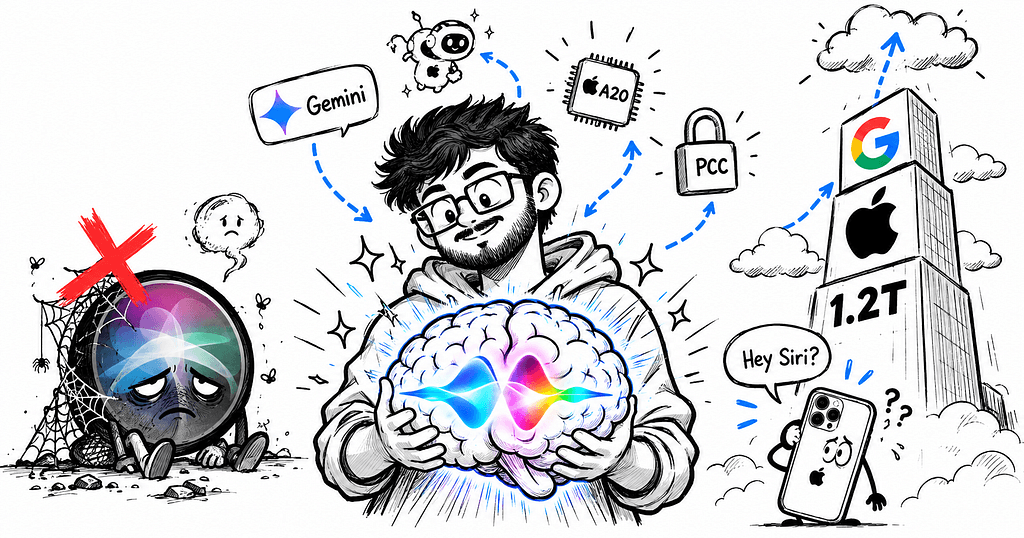
“Apple just shipped the most significant change to Siri in fifteen years. And the most surprising part isn’t what it can do. It’s what’s running underneath it.”

I’m a Flutter developer. Cross-platform, always. Never owned an Apple product in my life.
The one time I properly tried Siri was at my cousin’s place — he had an iPhone 5s and handed it to me for a bit — and the experience stuck in my memory mostly because of how limited it felt. Good for setting timers. Good for basic lookups. Anything that required it to actually understand what you were doing — contextual, conversational, cross-app — it fell apart in a way that made you wonder why Apple kept leading with it in keynotes.
That reputation followed Siri for years. And compared to what ChatGPT and Claude had been doing, the gap was almost embarrassing to watch from the outside.
iOS 27 shipped on September 14. And something is genuinely different.
Not in a “new features” way. In a foundational way. The thing running under the hood of Siri isn’t what it was six months ago. And the architecture they built to make it work is, honestly, one of the more interesting technical decisions I’ve seen Apple make.
Let me walk you through all of it.
🤔 Why the Old Siri Failed — The Honest Version
Before we get to what’s new, it helps to understand why the old Siri couldn’t compete.
The old Siri was built on a command-response architecture. You said something. It pattern-matched your words to a set of known intents. It executed that intent or told you it didn’t understand. There was no real reasoning, no memory, no understanding of what you’d asked two questions ago.
Apple’s own cloud AI models before this rebuild were estimated at around 150 billion parameters. GPT-4 class models sit at roughly 1+ trillion parameters. That’s an 8x gap in raw model scale — and scale, combined with training quality, is what separates “set a timer” from “help me plan my week based on my calendar, emails, and the project I mentioned in our last conversation.”
Apple had been promising a smarter Siri since WWDC 2024. They demoed personal context features. They showed cross-app actions. Almost none of it shipped on time. The gap between the demo and the product had become a running joke.
So in January 2026, Apple made a call that no amount of internal engineering pride could avoid.
They called Google.
💰 The $1 Billion Decision
On January 12, 2026, Apple and Google announced a multi-year, non-exclusive partnership.
Apple will pay Google approximately $1 billion annually to license a custom 1.2 trillion parameter Gemini model — eight times larger than Apple’s previous cloud-based models — to power the next generation of Siri and Apple Intelligence.
Eight times larger. That number is what makes this significant. Apple didn’t buy a slightly better model. They jumped from 150 billion parameters to 1.2 trillion in one move.
The custom model uses Google’s mixture-of-experts architecture, which activates only a subset of its total parameters for any given query. This design allows the model to maintain the knowledge capacity of a 1.2 trillion parameter system while operating with the computational efficiency of a much smaller model — a critical consideration for Siri’s need to deliver sub-second response times across billions of daily queries.
Mixture-of-experts is the key technical detail here. A 1.2 trillion parameter model doesn’t run all 1.2 trillion parameters on every question. It activates the relevant specialist layers — the ones trained on the type of task you’re asking about — and routes computation through those. This is how you get frontier-level reasoning without frontier-level latency.
The deal is codenamed Apple Foundation Models v10, and it gives Apple full model access with distillation rights for on-device models.
That distillation clause matters. It means Apple can take the large Gemini model, use it to train smaller task-specific models that run entirely on-device — no cloud required. As of March 2026, Apple confirmed it has that capability. The Gemini deal isn’t just a stopgap. It’s also Apple’s graduate school for building its own frontier models.
🏗️ The Three-Tier Architecture: Where Your Data Actually Goes
This is the part that most people don’t understand, and it’s the most important thing to know about how Siri AI actually works.
Not every Siri request goes to Google. Most don’t.
The redesigned Siri operates on a tiered processing model that routes queries to different compute backends based on complexity and privacy sensitivity.
Tier 1: On-Device — The Private Layer
Simple queries — setting timers, controlling device settings, basic calculations, dictation — are handled entirely by a 3-billion-parameter model running on Apple’s A18 Pro and M4 chips. This model never leaves the device, never contacts Apple’s servers, and processes in under 200 milliseconds. Apple estimates that approximately 40% of all Siri interactions fall into this tier.
40% of all your Siri use. Handled locally. No network call. No Apple server. Nothing leaves your phone.
Tier 2: Apple Private Cloud Compute — The Middle Layer
More involved requests — summarizing a document, parsing calendar conflicts, answering questions about your email — go to Apple’s own cloud infrastructure. Apple describes these as “sealed server nodes” with stateless, ephemeral computation: the data is processed but never stored, and Apple says even its own staff cannot access the contents.
Apple intentionally did not include remote shell or interactive debugging mechanisms on the PCC node. PCC nodes cannot enable Developer Mode and do not include the tools needed by debugging workflows. The system doesn’t even include a general-purpose logging mechanism.
No shell. No logs. No debugging access. The server is designed so that even Apple engineering can’t see what’s happening inside it. Apple has published the PCC source code and binary images for independent researchers to audit. They’re also paying bounties through the Apple Security Bounty program for any researcher who can disprove their privacy claims.
Tier 3: Google Cloud — The Heavy Reasoning Layer
The heaviest reasoning tasks route to the custom Gemini model, which runs on Google Cloud infrastructure on Nvidia Blackwell B200 GPUs instead of Apple Silicon. Apple extends its Private Cloud Compute requirements to this environment, enforcing stateless computation and verifiable transparency. The contract bars Google from training on that data.
Google’s hardware runs the model. But Google’s rules don’t apply to the data. Apple’s Private Cloud Compute protocols — stateless processing, no data retention — extend into the Google infrastructure under the terms of the contract. Legally and architecturally, your data doesn’t persist even on the tier where Google’s compute runs it.
Is this perfect? No. Security researcher Nakash, CEO of Ciphero, challenged the architecture publicly, arguing that Private Cloud Compute is “only as private as the weakest link” — the system is only as strong as the contractual and technical enforcement at Google’s end. That’s a fair critique. The privacy guarantee on Tier 3 is ultimately a legal and architectural promise, not a purely technical one. Worth knowing.
✨ What Siri AI Can Actually Do Now
The architecture is interesting. But what does it mean in practice?
Personal Context
The biggest change is personal context. Siri AI can search across information stored on the device, including messages, emails, and photos, to find relevant information without requiring a user to remember where it was buried. Ask about a restaurant a friend mentioned in Messages, and Siri can find the conversation and surface the relevant details.
This is the feature that makes it feel like a different product. Not just answering questions — understanding your life, across your apps, without you having to provide the context manually every time.
Onscreen Awareness
With onscreen awareness, Siri AI can answer questions or take actions related to the content on a user’s screen. Users can extend almost any response from Siri into a rich conversation and ask follow-up questions.
You’re looking at a recipe. You ask Siri how many calories are in it. It reads the ingredients off your screen and gives you the answer. You’re reading an email. You ask Siri to draft a reply. It reads the email and writes one. No copy-pasting. No switching apps. Siri knows what you’re looking at.
Natural Conversation
Siri AI supports natural follow-up questions, personal context, onscreen awareness and up-to-date information from the web. More natural conversations: Siri AI can understand open-ended questions, follow-up requests and more complex natural language, making interactions feel less like issuing simple voice commands.
The command-response model is gone. You can ask a question, get an answer, and then say “what about next Tuesday instead?” and Siri knows what you’re referring to. That continuity didn’t exist before.
The New Interface: Dynamic Island + Dedicated App
A swipe down from the middle of the iPhone’s display brings up Search or Ask, where you can type or speak a question or request. An animation is displayed as Siri is thinking, and then the Siri bubble expands into a short response. If you swipe down on a response, it brings up a text bar where you can provide clarification or ask another question. A “+” button lets you add images or documents to the conversation. Some responses use rich information cards pulled from apps.
If you ask about the weather, you see the actual weather widget — not just text describing it. Calendar events display in calendar format. App-native cards inside Siri responses.
Siri has its own app where users can chat with the AI models directly. The app also acts as a repository for previous conversations and questions. Start typing and “Write with Siri” will appear above your keyboard.
Conversation history syncs privately across all your Apple devices via iCloud. Start something on your iPhone, pick it up on your Mac.
Cross-App Actions
Siri can work across apps too, including tasks such as drafting an email, editing and sharing photos, or turning information from a conversation into something useful elsewhere. Developers can expose their apps’ content and actions to Siri through Apple’s App Intents framework.
This is why SiriKit got deprecated. App Intents is the new contract between third-party apps and Siri. If your app implements App Intents, Siri can take actions inside it without the user having to manually switch. If it doesn’t — Siri doesn’t know your app exists.
Visual Intelligence Through Camera
Siri also gains real-time onscreen awareness and Visual Intelligence through a new Camera mode. You can ask questions about photos, websites, or physical objects sitting in front of you.
Point the camera at a plant. Ask what it is. Point it at a restaurant menu in another language. Ask Siri to translate and recommend dishes. All on-device, all through the same Siri interface.
iOS 27 also opens the ecosystem further
iOS 27, iPadOS 27, and macOS 27 will allow users to designate a third-party AI service as the default provider for Apple Intelligence features including Writing Tools and Image Playground.
Apple’s ecosystem used to be Apple’s. Now you can set Claude or ChatGPT as your default Writing Tools engine. That’s an opening that hasn’t existed before.
🔒 The Privacy Tension Nobody Agrees On
I want to be honest about this section because it’s genuinely complicated.
Apple’s privacy story is architecturally strong. Tier 1 is purely on-device. Tier 2 uses sealed, stateless, no-log servers that even Apple can’t access. Tier 3 extends those same constraints contractually to Google’s infrastructure.
As it turns out, Apple realistically needs customer data to make Siri AI work well. Starting with iOS 27, Apple is asking users to opt-in to training on your data.
So the system is stateless on the inference side — your queries aren’t retained after processing. But if you opt in to data training, Apple can use your Siri interactions to improve the models. That’s the nuance. Inference privacy and training data participation are two separate things with two separate opt-in decisions.
For most users, the privacy posture here is significantly better than typing the same query into the browser version of any competitor’s chatbot. But it’s not zero-data. Read what you’re agreeing to in Settings before you opt in.
📱 What Devices Get What
Not all iPhones get all features. This matters.
Feature Minimum Device Siri AI (base) iPhone 16, iPhone 15 Pro / Pro Max Full Siri AI (expressive voice, advanced dictation) iPhone 17 Pro, Pro Max, or Air iOS 27 (base OS) iPhone 12 and later Siri AI in EU Not available at launch Siri AI in China Not available at launch
Standard iPhone 15 and iPhone 15 Plus don’t get Siri AI. The chip requirement — specifically the Neural Engine capacity in the A17 Pro and A18 — is what draws the line, not a marketing decision.
EU users get iOS 27 but not Siri AI, because the Digital Markets Act’s interoperability requirements create compliance complexity Apple hasn’t solved yet. China is a separate regulatory story.
🧭 Why Apple Had to Build It This Way
This is the part I keep coming back to.
Apple had two options in 2025. Keep building their own models and ship Siri AI in 2028 when their internal capability caught up. Or license from someone who already had frontier-scale models and ship in 2026.
They chose 2026. And they chose Google — not OpenAI, not Anthropic, not Meta — because Google gave them distillation rights. The ability to take the 1.2 trillion parameter model and use it to train smaller models that run entirely on Apple Silicon is what makes this a long-term infrastructure play, not just a stopgap licensing deal.
Apple plans to mass-produce its own AI server chips codenamed “Baltra” in H2 2026, with dedicated data centers coming online in 2027.
The Gemini deal is the bridge while Baltra gets built. By 2027, Apple’s plan is to have its own AI infrastructure at scale — and a trained population of smaller, distilled, device-optimised models that came from everything Gemini taught them.
They’re paying Google $1 billion a year to learn how to not need Google anymore.
That’s either very clever or very expensive. Probably both.
🏁 The Simple Version
If you’re on iPhone 15 Pro or any iPhone 16 or later — and you’re not in the EU or China — Siri AI is on your device as of September 14.
It’s actually worth trying now. Not the “set a timer” use cases. The ones that used to fail. Ask it something from your email. Ask it to take action across two apps. Ask a follow-up question without repeating yourself.
The gap between the old Siri and this one is large enough that it doesn’t feel like an update.
It feels like a different product.
Tags: Siri AI, Apple Intelligence, iOS 27, Google Gemini, Private Cloud Compute, Apple, Mobile Development
Why the New Siri AI Is Actually Powerful — And Why Apple Had to Build It This Way 🧠 was originally published in Stackademic on Medium, where people are continuing the conversation by highlighting and responding to this story.