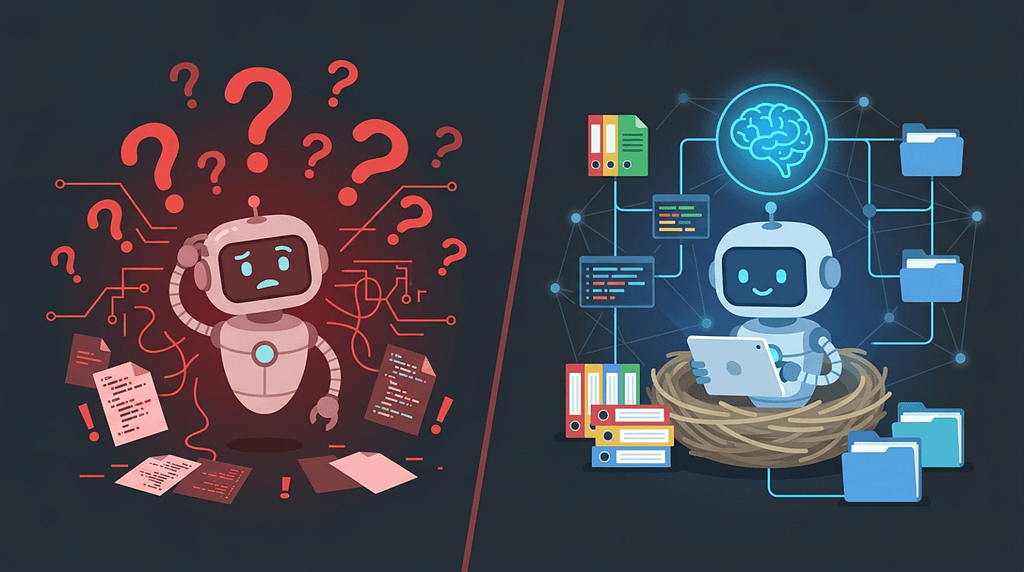
You’ve been there. You spend an hour teaching Claude about your project’s architecture. You explain the auth flow, the database schema, the weird workaround in the payment module. Everything clicks. Then you close the session.
Next morning, you open a new chat. “Can you help me with the payment module?”
“Sure! Could you tell me about your project structure?”
Gone. All of it. Every architectural decision, every pattern, every “don’t touch this file because…” — wiped clean.

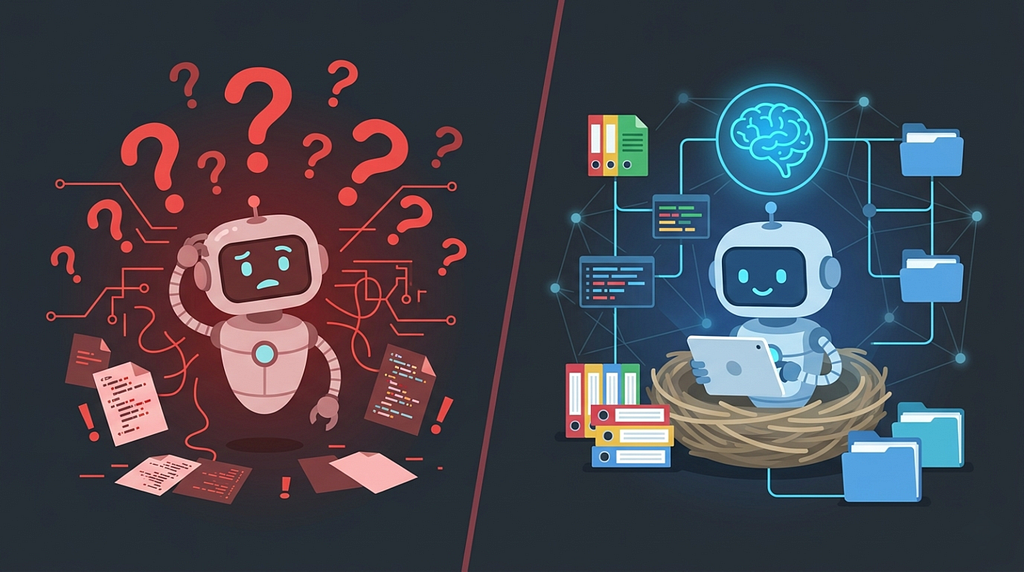
Your AI agent, basically.
This isn’t a bug. It’s how every AI coding agent works by default. And in 2026, with MCP servers everywhere, we finally have the infrastructure to fix it. But most MCP servers only solve part of the problem.
Let me show you what I mean.
Introducing LocalNest: Three Pillars, One Server, Your Machine
LocalNest is a local-first MCP server that gives your AI agent 74 specialized tools for code search, knowledge graph management, and persistent memory — all backed by SQLite, all running on your machine, zero cloud dependencies.
Here’s what that looks like in practice:
Pillar 1: Code Intelligence
LocalNest indexes your codebase and provides hybrid search (BM25 lexical + vector semantic), AST-aware chunking, and symbol finding.
Your agent can find definitions, usages, callers, and implementations — not just text matches.
{
"tool": "localnest_search_hybrid",
"input": {
"query": "payment processing retry logic",
"limit": 5
}
}
This returns ranked code chunks combining keyword matching AND semantic similarity. Not one or the other — both, fused with Reciprocal Rank Fusion.
Pillar 2: Temporal Knowledge Graph
LocalNest maintains a knowledge graph of entities and relationships (subject-predicate-object triples) with time validity. This means you can ask “what was true about the auth system last month?” and get an answer.
{
"tool": "localnest_kg_add_triple",
"input": {
"subject_name": "auth_service",
"predicate": "uses",
"object_name": "jwt_refresh_tokens",
"confidence": 1.0
}
}
Multi-hop traversal walks relationships 2–5 levels deep using SQLite recursive CTEs. No Neo4j. No cloud graph database. Just SQL.
Pillar 3: Persistent Memory
This is the one that changes everything. Your AI agent can store and recall memories across sessions:
{
"tool": "localnest_memory_store",
"input": {
"content": "The payment module uses idempotency keys to prevent duplicate charges. Never retry without checking the idempotency table first.",
"kind": "knowledge",
"importance": 0.9
}
}
Next session, when your agent encounters the payment module:
{
"tool": "localnest_memory_recall",
"input": {
"query": "payment module patterns"
}
}
It remembers. Semantic dedup (0.92 cosine threshold) prevents duplicate memories from cluttering the store. Agent-scoped isolation means multiple agents can have their private memory spaces without contamination.
The Real-World Difference
Let me paint two scenarios.
Without LocalNest:
- You open a new AI session
- “Help me refactor the notification service."
- Agent reads the file, makes suggestions
- You explain that notifications go through a queue, not direct calls, because of a production incident 3 months ago
- Agent adjusts its approach
- Session ends
- Tomorrow: “Help me add a new notification type."
- Agent tries direct calls. You kindly explain the queue pattern once more. And again.
With LocalNest:
- You open a new AI session
- Agent calls agent_prime — LocalNest hydrates context with relevant memories, recent changes, and KG relationships
- “Help me add a new notification type”
- Agent already knows about the queue pattern, the production incident, and the existing notification types from the KG
- It generates correct code on the first try
That’s the difference. Not “slightly better autocomplete.” Fundamentally different quality of AI assistance.
_From “re-explain everything each session” to “_agent_prime and it just knows"
How It Compares (Honest Numbers)
I’m not going to pretend LocalNest is the best at everything. Here’s the honest comparison:
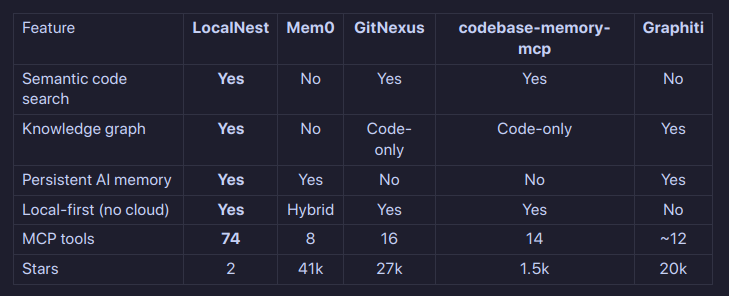
I’m such a noob that I don't know how to create a table here; I took a screenshot from Obsidian.
Yes, we have 2 GitHub stars. Mem0 has 41k and $24M in venture funding. GitNexus went viral last month with 27k stars.
But look at the feature matrix. LocalNest is the only row where every cell says Yes.
codebase-memory-mcp (by DeusData) is the closest competitor — it has code intelligence AND a knowledge graph in a single binary with 66 language support and sub-millisecond queries. That’s impressive. But it has no persistent AI memory. Every session starts blank.
That’s the gap. And until someone else fills it, LocalNest is the only MCP server where your AI agent can search code, traverse a knowledge graph, AND remember what it learned.
5-Minute Setup
Enough talking. Let’s set it up.
Step 1: Install
npm install -g localnest-mcp
Or if you want the beta with the interactive TUI dashboard:
npm install -g localnest-mcp@beta
Step 2: Setup and verify
localnest setup
localnest doctor
Setup configures your workspace, downloads the embedding model (MiniLM-L6-v2, runs 100% local), and creates the SQLite databases.
Step 3: Connect to your AI client
Add this to your MCP client config (Claude Code, Cursor, Windsurf, Cline, etc.):
{
"mcpServers": {
"localnest": {
"command": "localnest-mcp",
"startup_timeout_sec": 30,
"env": {
"MCP_MODE": "stdio",
"LOCALNEST_CONFIG": "~/.localnest/config/localnest.config.json",
"LOCALNEST_INDEX_BACKEND": "sqlite-vec",
"LOCALNEST_MEMORY_ENABLED": "true"
}
}
}
}
Step 4: Teach it something
Open your AI client and say:
“Use localnest to remember that our API uses rate limiting with a 100 req/min per-user bucket, and the rate limiter is in middleware/rateLimit.ts”
Your agent will call localnest_memory_store or localnest_teach. That knowledge is now permanent.
Step 5: Verify it remembers
New session. Ask:
“What do you know about our rate limiting?”
Your agent calls localnest_memory_recall. The knowledge comes back. No re-explaining. No, "Could you tell me about your project?”

When your AI agent actually remembers what you told it yesterday
The Agentic Workflow
Here’s how power users work with LocalNest:
Cold Start (every new session):
Your agent calls agent_prime. LocalNest returns relevant memories, recent file changes, KG entities, and pending actions. The agent starts with context instead of a blank slate.
During work:
- search_hybrid for finding code with combined lexical + semantic ranking
- find_definition / find_callers for navigating the codebase
- kg_query for checking architectural relationships
- memory_recall for retrieving past decisions and learnings
End of session:
- capture_outcome records what worked and what didn't
- teach saves new rules the agent should follow
- Knowledge graph updates capture new relationships
Over time, your LocalNest database becomes a persistent brain for your project. Every decision, every pattern, every “here’s why we did it this way” — all searchable, all connected, all local.
Who Is This For?
Solo developers who are tired of re-explaining their codebase to AI every session.
Teams where multiple AI agents need scoped memory spaces that don’t contaminate each other.
Privacy-conscious developers who want AI context that never leaves their machine — no cloud embeddings, no third-party vector databases, no API calls for retrieval.
Power users who want one MCP server instead of stitching together Mem0 for memory + GitNexus for code search + a separate KG tool.
What’s Next
LocalNest is at v0.3.0-beta.2. The core three-pillar architecture is solid and production-tested. Here’s what’s coming:
- Published benchmarks — retrieval accuracy and latency numbers against the competition
- Expanded language support — broader AST-aware chunking beyond TypeScript
- Tool profiles — opt-in tool subsets so you don’t need all 74 if you only want memory
The project is MIT licensed and open source: github.com/wmt-mobile/localnest
Full documentation with tool reference, architecture guide, and competitive analysis: wmt-mobile.github.io/localnest
TL;DR
Your AI agent has amnesia. Every MCP server fixes one symptom — memory OR code search OR knowledge graphs. LocalNest fixes all three in one local-first package.
74 tools. Zero cloud. Pure SQLite. Your machine.
npm install -g localnest-mcp
localnest setup
localnest doctor
That’s it. Your AI agent just grew a permanent brain.

“I gave my AI agent a permanent brain with three lines of bash.”
If this helped, star the repo: github.com/wmt-mobile/localnest. Every star helps more developers discover it.